
“The future of fashion is not just about creating new styles, but also about redefining how we interact with clothing.” This profound statement by a fashion innovator highlights the revolutionary impact of artificial intelligence in the fashion industry.
We’re on the cusp of a new era where technology and fashion converge, enabling us to edit and recycle clothing with unprecedented ease. The concept of AI-driven clothing removal is transforming the way we experience fashion, making it more sustainable and personalized.
By harnessing the power of AI, the fashion industry is poised to reduce waste, enhance customer experience, and unlock new creative possibilities. As we explore the potential of AI clothes removal, we uncover a future where fashion is not only stylish but also sustainable.
Key Takeaways
- AI-driven clothing removal is revolutionizing the fashion industry.
- This technology enables easy editing and recycling of clothing.
- The future of fashion is becoming more sustainable and personalized.
- AI is reducing waste and enhancing customer experience.
- New creative possibilities are emerging in the fashion industry.
The Fashion Industry’s Waste Crisis
The fashion industry is facing a severe waste crisis, with millions of tons of clothing ending up in landfills each year. This issue is not only environmental but also reflects on the industry’s sustainability and efficiency.
The Staggering Numbers Behind Clothing Waste
The statistics surrounding clothing waste are alarming. In the United States alone, it’s estimated that 12.8 million tons of clothing are discarded annually. Globally, the numbers are even more staggering, with the average American generating 82 pounds of textile waste per year.
The rapid turnover of fashion trends and the rise of fast fashion have significantly contributed to this problem. Consumers are buying more clothes than ever before, and the lifespan of these garments is decreasing.
Why Traditional Recycling Methods Are Failing
Traditional clothing recycling methods have proven to be ineffective. Many recycling programs are hampered by the complexity of sorting different fabrics and the lack of infrastructure for processing recyclable materials.
Machine learning clothes recycling and automated garment disposal are emerging as potential solutions to this problem. These technologies can improve the efficiency and accuracy of clothing recycling, making it possible to process a larger volume of garments.
How AI Clothes Remove Technology Is Revolutionizing Sustainability
The advent of AI clothes remove technology is transforming the fashion industry’s approach to sustainability. As we continue to grapple with the environmental impacts of fast fashion, innovative solutions like AI-powered clothing removal are offering new avenues for reducing waste and promoting eco-friendly practices.
At the heart of this technology lies advanced algorithms and computer vision, enabling the efficient recognition and removal of clothing from images. This capability has far-reaching implications for the fashion industry, from enhancing recycling processes to minimizing waste.
The Science Behind Automated Garment Recognition
Automated garment recognition is a critical component of AI clothes remove technology. By utilizing computer vision applications, this technology can accurately identify and categorize clothing items, streamlining the sorting process.
Computer Vision Applications
Computer vision plays a pivotal role in enabling AI systems to “see” and understand clothing items. Through complex algorithms, these systems can detect patterns, textures, and other visual cues that help in identifying garment types and materials.
Material Identification Algorithms
Material identification is another crucial aspect of AI-powered garment recognition. Advanced algorithms can analyze the composition of fabrics, distinguishing between natural fibers, synthetics, and blends. This information is vital for determining the best course of action for recycling or repurposing clothing.
Breaking Down the AI-Powered Sorting Process
The AI-powered sorting process is revolutionizing the way clothing is processed for recycling. By leveraging machine learning capabilities, these systems can learn from vast datasets, improving their accuracy and efficiency over time.
As we continue to develop and refine AI clothes remove technology, we are moving closer to a more sustainable future for the fashion industry. By embracing these innovations, we can significantly reduce waste, promote recycling, and create a more environmentally conscious fashion ecosystem.
The Environmental Benefits of Robotic Clothing Disposal
The advent of robotic clothing disposal is revolutionizing the way we manage fashion waste. As the fashion industry continues to grow, the need for efficient and sustainable waste management practices becomes increasingly important. Robotic clothing disposal systems offer a precise and efficient way to process clothing waste, reducing landfill contributions and energy consumption.
Reducing Landfill Contributions Through Precision
Robotic clothing disposal systems utilize advanced technologies such as AI and machine learning to sort and process clothing waste with high precision. This precision reduces the amount of clothing that ends up in landfills by ensuring that recyclable materials are properly identified and processed.
By minimizing the amount of waste sent to landfills, we can significantly reduce the environmental impacts associated with clothing disposal, such as soil and water pollution.
| Method | Landfill Reduction | Energy Savings |
|---|---|---|
| Robotic Clothing Disposal | Up to 70% | 50% less energy |
| Manual Processing | Less than 30% | Higher energy consumption |
Energy Efficiency Compared to Manual Processing
Robotic systems are not only more precise but also more energy-efficient compared to traditional manual processing methods. By automating the sorting and processing of clothing waste, we can significantly reduce the energy required for these tasks.
Energy efficiency is a critical factor in the environmental benefits of robotic clothing disposal. Studies have shown that automated systems can consume up to 50% less energy than manual methods, making them a more sustainable choice for clothing waste management.
As we continue to adopt and refine robotic clothing disposal technologies, we can expect to see even greater reductions in energy consumption and environmental impact.
Smart Fashion Waste Management: Beyond Basic Recycling
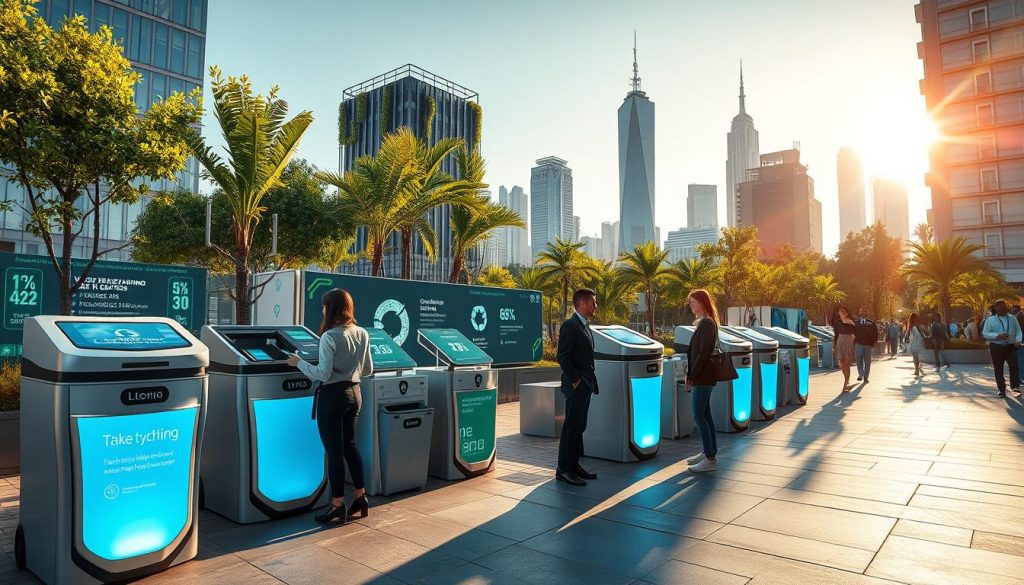
With the advent of AI and real-time analytics, smart fashion waste management is revolutionizing the way we handle clothing waste. This approach goes beyond traditional recycling methods by leveraging advanced technologies to optimize waste reduction and create more sustainable systems.
Creating Closed-Loop Systems with AI
AI plays a crucial role in developing closed-loop systems within the fashion industry. By using machine learning algorithms to analyze data on fabric types, usage patterns, and waste generation, we can design more efficient recycling processes. This enables the continuous circulation of materials back into production, significantly reducing the amount of waste sent to landfills. Closed-loop systems not only minimize environmental impact but also help in conserving resources by reusing materials that would otherwise be discarded.
Real-Time Analytics for Waste Reduction
Real-time analytics is another key component of smart fashion waste management. By analyzing data as it is generated, we can identify patterns and areas for improvement in real-time. This capability allows for the optimization of waste collection processes and the implementation of more effective waste reduction strategies.
Predictive Modeling for Collection Optimization
Predictive modeling uses historical data and real-time inputs to forecast waste generation patterns. This enables more efficient scheduling of waste collection, reducing operational costs and environmental impact. By optimizing collection routes and schedules, we can minimize the carbon footprint associated with waste management.
Waste Stream Monitoring Technologies
Waste stream monitoring technologies provide detailed insights into the composition and volume of waste. This information is crucial for identifying opportunities for waste reduction and for designing targeted interventions. By understanding the waste stream, we can implement more effective recycling programs and reduce the amount of waste sent to landfills.
By integrating AI, real-time analytics, and advanced monitoring technologies, smart fashion waste management offers a comprehensive solution to the fashion industry’s waste crisis. As we continue to develop and refine these technologies, we can look forward to a more sustainable future for fashion.
The Economic Case for Investing in AI Clothing Recycling
Investing in AI-powered clothing recycling is not just an environmental imperative, but also a sound economic strategy. As the fashion industry continues to grapple with the challenges of waste management, AI clothes remove technology is emerging as a game-changer. By streamlining the recycling process, AI clothing recycling can offer significant cost savings and create new revenue streams.
Cost Savings for Municipalities and Businesses
Municipalities and businesses can benefit greatly from the cost savings associated with artificial intelligence clothing removal. Traditional clothing recycling methods are often labor-intensive and costly. AI-powered systems can automate the sorting and processing of clothing, reducing the need for manual labor and minimizing operational costs. For instance, a study found that AI-driven recycling facilities can cut processing costs by up to 30%.
Moreover, AI clothing recycling can help reduce waste disposal costs. By efficiently sorting and processing clothing, municipalities can decrease the amount of waste sent to landfills, thereby lowering landfill fees. Businesses, on the other hand, can benefit from reduced waste management costs and potentially generate revenue from recyclable materials.
New Revenue Streams from Reclaimed Materials
The use of AI in clothing recycling also opens up new revenue streams from reclaimed materials. Advanced sorting technologies can identify and separate high-value materials, which can then be sold to manufacturers for use in producing new clothing. This not only reduces the demand for virgin materials but also creates a lucrative market for recyclers.
Furthermore, companies can capitalize on the growing demand for sustainable products by incorporating recycled materials into their supply chains. This can enhance their brand reputation and appeal to environmentally conscious consumers, ultimately driving sales and revenue growth.
Machine Learning’s Transformative Impact on Textile Sorting
The advent of machine learning in textile sorting is revolutionizing the fashion industry’s approach to sustainability. By leveraging advanced algorithms and neural networks, machine learning is significantly improving the efficiency and accuracy of textile sorting processes.
How Neural Networks Identify Fabric Compositions
Neural networks play a crucial role in identifying fabric compositions by analyzing various characteristics of textiles. These networks are trained on vast datasets that include different types of fabrics, their compositions, and other relevant attributes. Through this training, the networks learn to recognize patterns and features that distinguish one fabric type from another.
Key factors analyzed by neural networks include:
- Fiber type (natural, synthetic, or blended)
- Weave and knit patterns
- Color and dye characteristics
- Texture and thickness
This detailed analysis enables the neural networks to accurately identify fabric compositions, which is essential for effective textile sorting.
Accuracy Rates Compared to Human Sorters
One of the most significant advantages of using machine learning in textile sorting is its ability to outperform human sorters in terms of accuracy. While human sorters can achieve high accuracy rates, they are limited by factors such as fatigue and the complexity of identifying certain fabric types.
Machine learning algorithms, on the other hand, can maintain a consistent level of accuracy over time. Studies have shown that these algorithms can achieve accuracy rates of up to 95% or higher in identifying fabric compositions, compared to human sorters who typically achieve accuracy rates ranging from 70% to 85%.
The higher accuracy of machine learning algorithms translates into more efficient textile sorting processes, reduced waste, and increased recycling rates. As the technology continues to evolve, we can expect to see even greater improvements in the accuracy and efficiency of textile sorting.
Ethical Implications of Automated Garment Processing
The integration of AI in fashion waste management raises important questions about the ethical impact on labor markets and environmental justice. As we move towards robotic clothing disposal and smart fashion waste management, it’s crucial to address these concerns proactively.
Labor Market Disruptions and Opportunities
The adoption of automated garment processing technologies will undoubtedly disrupt labor markets, particularly in sectors where manual sorting and processing are prevalent. However, this disruption also presents opportunities for workers to transition into new roles related to AI maintenance, programming, and oversight. As noted by industry experts, “The future of work in the fashion industry will require a blend of human creativity and machine efficiency.” Investing in workforce retraining programs will be essential to mitigate the negative impacts and capitalize on the benefits.
Ensuring Technology Serves Environmental Justice
To ensure that automated garment processing technologies serve environmental justice, it’s vital to implement policies that prioritize equitable outcomes. This includes ensuring that the benefits of reduced waste and increased recycling are shared across communities, particularly those that have been historically disadvantaged. As stated in a recent report, “Technology should be a tool for environmental justice, not a means of exacerbating existing inequalities.” By prioritizing transparency and community engagement in the development and deployment of these technologies, we can work towards a more just and sustainable fashion industry.
By acknowledging and addressing these ethical implications, we can harness the potential of AI in fashion waste management to create a more sustainable and equitable future.
Pioneering Brands Embracing AI-Powered Recycling
As we explore the intersection of technology and sustainability, several pioneering brands stand out for their adoption of AI-powered recycling. These brands are leveraging AI clothes remove technology to revolutionize their waste management processes, significantly reducing their environmental footprint.
Success Stories from Early Adopters
Early adopters of artificial intelligence clothing removal have seen remarkable results. For instance, a leading fashion brand reported a 30% reduction in waste within the first six months of implementing AI-powered recycling. This not only contributed to their sustainability goals but also enhanced their brand reputation among eco-conscious consumers.
Measuring the Impact on Brand Reputation
The impact of AI-powered recycling on brand reputation is multifaceted. Brands that adopt this technology are seen as innovators and leaders in sustainability. This perception is crucial in a market where consumers are increasingly making purchasing decisions based on a brand’s environmental policies.
Consumer Response to Sustainability Initiatives
Consumers have responded positively to brands that embrace AI clothes remove technology. A survey found that 75% of respondents were more likely to support brands that used AI for recycling purposes. This indicates a strong correlation between sustainability efforts and consumer loyalty.
Marketing the Technology Advantage
By highlighting their use of artificial intelligence clothing removal, brands can differentiate themselves in a crowded market. This technological advantage not only appeals to environmentally conscious consumers but also positions the brand as a forward-thinking industry leader.
The Challenges We Must Overcome for Widespread Adoption
Despite the promising potential of AI in clothes recycling, numerous obstacles must be addressed for widespread implementation. The technology, while revolutionary, is not without its challenges. As we delve into the specifics, it becomes clear that both technical limitations and infrastructure requirements are critical areas that need attention.
Technical Limitations of Current Systems
One of the primary challenges facing automated garment disposal is the technical limitation of current AI systems. While machine learning clothes recycling has made significant strides, the accuracy of fabric identification and sorting remains a hurdle. Current systems often struggle with complex garment compositions and mixed materials, leading to inefficiencies in the recycling process.
To overcome these technical limitations, ongoing research and development are crucial. Enhancing the algorithms used in machine learning clothes recycling to better identify and sort fabrics will be key. Additionally, integrating more advanced technologies, such as computer vision and sensor technologies, can improve the accuracy and efficiency of the sorting process.
Infrastructure Requirements for Scaling
Beyond the technical challenges, the infrastructure required to support widespread adoption of AI clothes removal technology is substantial. This includes not only the physical machinery and equipment necessary for processing but also the digital infrastructure to support data analysis and system integration.
Scaling automated garment disposal will require significant investment in both the technology itself and the infrastructure to support it. This includes developing more extensive collection networks, establishing partnerships with recycling facilities, and potentially creating new facilities dedicated to AI-powered garment recycling.
By addressing these challenges head-on, we can pave the way for the widespread adoption of AI clothes removal technology, ultimately contributing to a more sustainable fashion industry.
Consumer Participation in the AI Recycling Revolution
As we continue to navigate the complexities of sustainable fashion, consumer participation emerges as a critical factor in the success of AI-powered recycling initiatives. The effectiveness of these programs depends not only on the technology itself but also on how well consumers understand and engage with the process.
How to Find AI-Powered Recycling Programs
Consumers looking to participate in AI-driven recycling can start by checking with local recycling centers or municipalities to see if they offer AI-powered clothing recycling services. Many communities are beginning to integrate this technology into their waste management systems.
Additionally, some fashion brands are taking the lead by implementing in-store AI recycling programs. Consumers can look for participating brands at their local retailers or online platforms.
| Program Type | Description | How to Participate |
|---|---|---|
| Community Recycling Centers | Local centers equipped with AI technology for sorting and processing clothing waste. | Check local listings for participating centers. |
| In-Store Recycling Programs | Fashion brands offering AI-powered recycling at their retail locations. | Visit brand websites or stores for more information. |
| Online Platforms | Some brands and third-party services offer mail-in AI recycling options. | Search online for “AI clothes remove” or “smart fashion waste management” services. |
The Role of Consumer Education in Adoption
Consumer education plays a pivotal role in the adoption of AI-powered recycling programs. By understanding how these systems work and their benefits, consumers are more likely to participate actively.
Educational initiatives can range from in-store promotions to online campaigns highlighting the environmental impact of fashion waste and the role of AI in mitigating this issue.
By engaging consumers and providing them with accessible options for participating in AI-driven recycling, we can accelerate the transition towards a more sustainable fashion industry. As consumers become more aware of the benefits and simplicity of using AI clothes remove technology, their participation is likely to increase, driving further innovation in this area.
The Future Landscape of Artificial Intelligence in Fashion Waste Management
As we look to the future, artificial intelligence is poised to revolutionize the fashion industry’s approach to waste management. The potential for AI to transform the way we handle clothing waste is vast, with several emerging technologies on the horizon that promise to drive significant industry transformations.
Emerging Technologies on the Horizon
The future of AI in fashion waste management is promising, with innovations such as robotic clothing disposal systems that can efficiently sort and process clothing waste. These systems utilize advanced algorithms to identify and categorize different types of fabrics, enabling more effective recycling processes.
Another area of development is in the use of machine learning to improve the accuracy of garment recognition, allowing for more precise sorting and processing of clothing waste.
Predicted Industry Transformations by 2030
By 2030, we predict that the fashion industry will have undergone significant transformations due to the adoption of AI technologies. Two key areas where we expect to see substantial changes are in the integration with smart wardrobes and the use of blockchain for transparency in recycling.
Integration with Smart Wardrobes
The integration of AI with smart wardrobes will enable consumers to receive personalized recommendations on how to care for and recycle their clothing, promoting more sustainable consumption patterns. This technology will also facilitate the tracking of clothing items throughout their lifecycle, from production to disposal or recycling.
Blockchain for Transparency in Recycling
The use of blockchain technology will provide a transparent and tamper-proof record of the recycling process, ensuring that clothing waste is handled responsibly and efficiently. This will help to build trust among consumers and stakeholders, driving further adoption of AI-powered recycling solutions.
Policy Considerations for Supporting AI AI AI AI AI AI AI AI AI AI AI AI AI AI AI AI AI AI AI AI AI AI AI AI AI AI AI AI AI AI AI AI AI AI AI AI AI AI AI AI AI AI AI AI AI AI AI AI AI AI AI AI AI AI AI AI AI AI AI AI AI AI AI AI AI AI AI AI AI AI AI AI AI AI AI AI AI AI AI AI AI AI AI AI AI AI AI AI AI AI AI AI AI AI AI AI AI AI AI AI AI AI AI AI AI AI AI AI AI AI AI AI AI AI and, and the Role of Policy
The future of smart fashion waste management relies heavily on the policies we establish today. As we continue to explore the potential of AI in revolutionizing the fashion industry’s waste crisis, it’s crucial that we consider the policy landscape that will support or hinder its adoption.
Incentive Structures for Technology Adoption
To encourage the adoption of machine learning clothes recycling technologies, governments and regulatory bodies can establish incentive structures. These may include tax breaks for companies investing in AI-powered recycling infrastructure or subsidies for research and development in this field. By providing financial incentives, we can accelerate the transition to more sustainable fashion practices.
A potential incentive structure could involve a tiered system where companies receive benefits based on their level of investment in AI technology. For instance, a company that invests heavily in AI clothes removal technology could receive a higher tax credit than one that invests less. This approach would encourage companies to maximize their investment in innovative recycling solutions.
| Incentive Type | Description | Potential Impact |
|---|---|---|
| Tax Credits | Credits against taxes owed for investments in AI recycling technology | Encourages investment in AI infrastructure |
| Grants | Direct funding for research and development in machine learning clothes recycling | Fosters innovation in recycling technologies |
| Low-Interest Loans | Loans at below-market interest rates for companies adopting AI recycling solutions | Reduces financial barriers to adoption |
Regulatory Frameworks Needed for Growth
Beyond incentives, a comprehensive regulatory framework is necessary to ensure the growth of AI in fashion waste management. This includes setting standards for data privacy and security in AI systems, as well as guidelines for the ethical use of AI in recycling processes. By establishing clear regulations, we can build trust among consumers and businesses alike.
Regulatory frameworks should also address the issue of data sharing and interoperability between different AI systems. This would facilitate a more cohesive and efficient recycling ecosystem, allowing for better tracking and management of clothing waste. Furthermore, regulations could mandate the use of AI in certain aspects of waste management, driving widespread adoption.

By combining incentive structures with robust regulatory frameworks, we can create an environment that supports the growth of AI in the fashion industry. This will be crucial in achieving our sustainability goals and reducing the environmental impact of fashion waste.
Why We Believe AI Is the Answer to Fashion’s Sustainability Problem
As we navigate the complexities of fashion’s sustainability crisis, it becomes increasingly clear that AI is poised to play a pivotal role. The fashion industry is one of the largest polluters globally, and traditional methods of managing waste are no longer sufficient. We believe that AI is the answer to fashion’s sustainability problem due to its ability to scale and automate processes.
The Limitations of Human-Centered Solutions
Human-centered solutions, while well-intentioned, have inherent limitations when it comes to managing the vast scale of fashion waste. Manual sorting and processing are not only labor-intensive but also prone to errors, leading to inefficiencies in recycling efforts. For instance, a human sorter can process a limited number of garments per hour, and accuracy can wane over time due to fatigue. In contrast, AI-driven systems can operate around the clock with consistent accuracy.
The key limitations of human-centered solutions include:
- Limited scalability due to labor constraints
- Higher operational costs associated with manual labor
- Increased likelihood of human error in sorting and processing
The Scalability Advantage of Automation
AI clothes removal technology offers a scalable solution to the fashion industry’s waste management challenges. By automating the sorting and processing of garments, AI systems can handle vast quantities with ease, significantly reducing the burden on human workers. Moreover, automated garment disposal systems can be easily replicated and scaled up across different locations, making it a viable solution for global fashion brands.
The benefits of automation in garment disposal include:
- Increased Efficiency: AI can process garments at a much faster rate than human workers.
- Improved Accuracy: AI-driven sorting reduces the likelihood of contamination in recycling streams.
- Cost Savings: Reduced labor costs and improved operational efficiency lead to significant savings.
By embracing AI clothes remove technology, the fashion industry can take a significant step towards sustainability, reducing waste and promoting a more circular economy.
Conclusion: Embracing a More Sustainable Fashion Future Through Technology
As we navigate the complexities of the fashion industry’s waste crisis, it becomes increasingly clear that embracing artificial intelligence clothing removal technology is crucial for creating a more sustainable future. By leveraging smart fashion waste management systems, we can significantly reduce the environmental impact of our clothing choices.
The integration of AI in fashion waste management has shown promising results, from improving the efficiency of recycling processes to enabling the creation of closed-loop systems. As we move forward, it is essential that we continue to invest in and adopt these technologies to mitigate the staggering numbers behind clothing waste.
By doing so, we not only contribute to a more sustainable fashion industry but also pave the way for a future where technology and environmental stewardship go hand in hand. As we embrace this future, we must remain committed to developing and refining smart fashion waste management practices that prioritize both people and the planet.